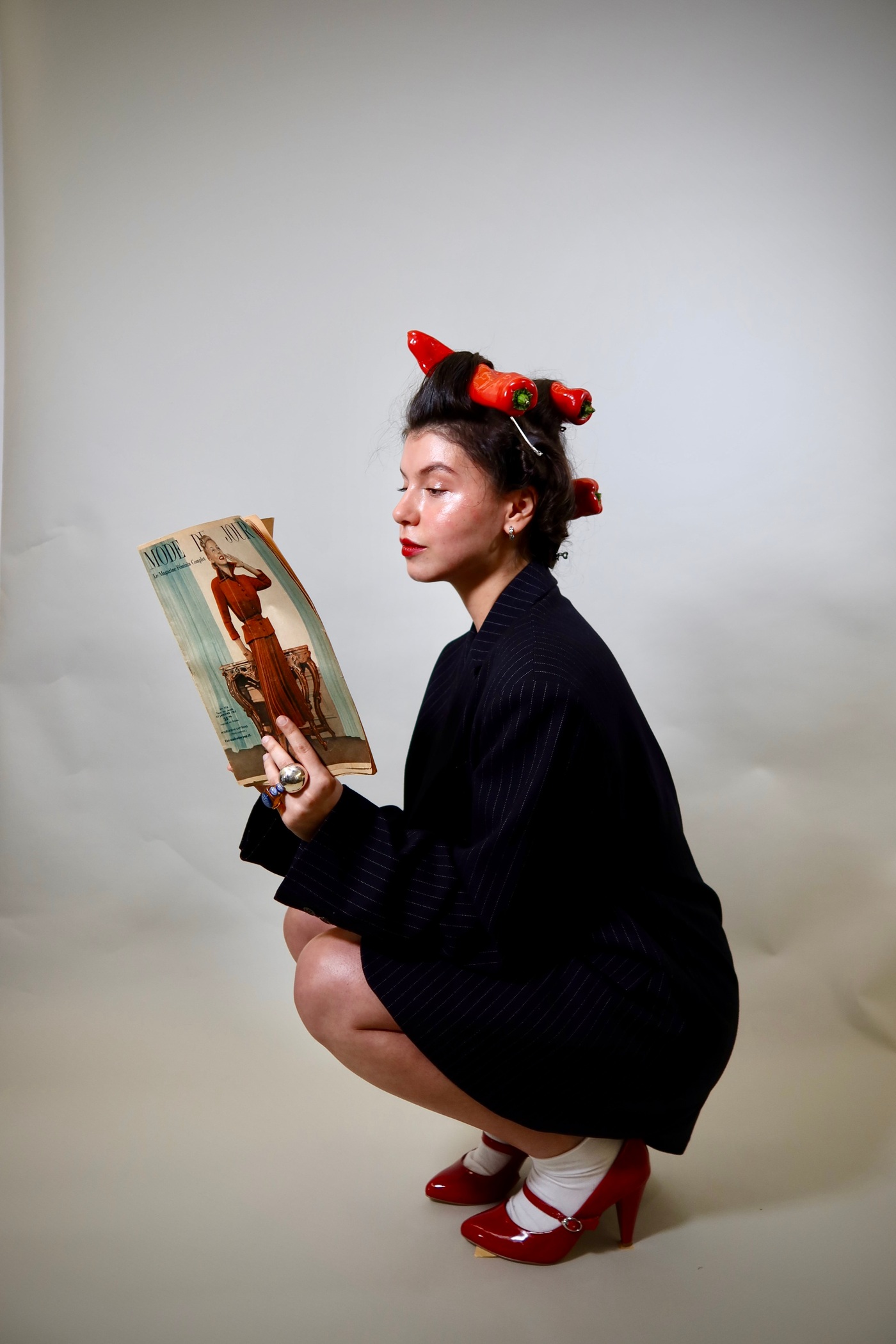
When did time stop belonging to us? When you analyze the idea of time in the modern age, the concept itself is very masculine; it became a construct that could be rigidly divided into units, which could then be extracted and sold. It was a way to answer the question: how much work can be accomplished in a set amount of linearly measured time? Time used to function in a deeply feminine way, organized around the body and the moon, long before it became the rigid, sellable unit we know now. The question is, when did time get colonized?
Before clocks, before factories, before anyone needed to ask "how much can I get done in an hour," time was task-oriented. A "day" was the time it took to milk the herd or wait for bread to rise. In other words, work and time weren't separated yet; they were the same thing. The historian E.P. Thompson is the one who actually named this shift: once industrial capitalism became integrated, time got abstracted into standardized units, and a worker's time essentially became the employer's money. Time not spent "productively" was a waste. Sound familiar? It's the same logic running every hustle-culture LinkedIn post today, just with the serial numbers filed off.
What's interesting is what got replaced. The most reliable, recurring rhythm available to early humans wasn't something conceptual; it was the moon. And the moon's cycle, which is roughly 29.5 days, lines up almost exactly with the average menstrual cycle. Ancient cultures noticed this constantly, and they built entire systems of meaning around it, long before anyone had the science to explain why.
You can see it directly within language. "Menstruation" comes from the Latin mensis, meaning month, rooted in Rome's lunar calendar. In Gaelic, the word for "menstruation" and the word for "calculation" are literally the same word. Across totally unrelated language families, the vocabulary for "moon" and the vocabulary for "menstrual cycle" keep converging, as if dozens of separate cultures independently landed on the same idea: the sky and the body were running on the same clock.
Myth backs this up too. The Maori described the moon as “the permanent husband of all women”, because women menstruate when it appears. Among the Maya, it was common knowledge that the calendar itself had originally been built on women's cycles. Claude Lévi-Strauss, going through myth across North and South America, found the same anxiety recurring over and over: that without women's cycles staying in sync with the wider cosmos, things could fall into chaos.
Even the archaeological record is in on this. The Venus of Laussel, a carving made over 20,000 years ago in France, shows a woman with one hand on her stomach, the other holding a bison horn etched with thirteen notches, which represents thirteen lunar cycles a year. Also, conveniently, close to the average number of periods a woman has annually. Some archaeologists think this is one of the earliest known calendars, which was not built for harvests or kings, but for the body.
Now, I'll be honest about where the research gets murky: whether menstrual and lunar cycles still sync up biologically today is genuinely contested. Some long-term studies have found intermittent overlap, especially without exposure to artificial light at night; newer studies using period-tracking apps have found basically nothing. So if you go looking for a clean scientific consensus here, you won't find one. But that's almost beside the point. Civilizations didn't need a lab to decide the moon and the menstrual body kept the same calendar; they organized ritual, agriculture, and daily life around that belief for thousands of years. The culture is undeniable even where biology is still up for debate.
So what happened? Unfortunately, colonization happened, and not just to land and labor, but to time itself. European colonial administrations didn't just bring new borders and new economies; they brought clock towers, time signals, and standardized schedules, using them as tools of control. Historians actually have a term for this: "the disciplining of time", which means replacing local, lunar, body-based rhythms with one synchronized, exportable standard that happened to be extremely convenient for running plantations and factories from an ocean away. It's the same transformation Thompson tracked happening inside England, just exported wholesale to the rest of the world.
This newfound concept of time led to the development of new tools of control. In the 19th century, plantation owners were one of the first to pioneer the use of the spreadsheet. At the time, the “spreadsheet” was done on pre-printed book accounts, used as a way to monitor how much labor could be extracted from their slaves per unit of time. The reasoning behind this is the same reasoning used in modern-day labor: it was a tool made to use people in order to maximize profit.
And once that system took hold, the moon simply had no place left in it. A lunar month doesn't divide cleanly into a fiscal quarter. A period doesn't clock in and out. The feminine, cyclical time that had run human life for millennia wasn't disproven or outgrown. In reality, it was simply bad for business, leading it to be phased out.
It cannot be ignored that pre-colonial life wasn’t easy, or that clocks haven't done a lot of good. Of course, there are benefits to this new-found system (who it benefits is another question, but I digress). However, something specific did get lost in translation: a model of time where the body wasn't an obstacle to productivity, because the body's rhythm was the time being kept. The question asked wasn't "what can I extract from you today," but something closer to "where are you in your cycle, and what does that call for right now." Rest wasn't a failure to optimize. It was just one phase, as expected and unremarkable as the moon going dark between one crescent and the next.
We inherited a version of time that treats every hour as interchangeable and every body as a unit of labor that should be running on schedule, no exceptions. Getting back even a sliver of the older model isn't some woo-woo retreat into superstition. Instead, it's a reminder that for most of human history, time wasn't something you answered to: it was something you moved with. Women, watching the sky and their own bodies, figured that out first.
So next time someone tells you to "manage your time better," ask yourself:
whose clock are you even running on?