If you turn on the US Open right now, you’ll notice something that has become so normalized that it barely registers: almost every woman, on and off the court, is wearing a tennis skirt. Interestingly enough, nowhere in the WTA rulebook does it state that a woman has to wear a skirt in order to play professional tennis. And yet, it clearly has become the default. So if nobody's making them, then why does it still feel mandatory?
In the 1800s, tennis was one of the only sports Victorian women were allowed to play in public at all, precisely because it was seen as passive enough not to threaten anyone's idea of femininity. The uniform women were expected to wear while playing represented that exactly: tight corsets, ankle length skirts, and high collars buttoned up to their throats. It was, by any physical standard, absurd. Women were being invited onto a court while wearing clothing that made it nearly impossible to bend for a low ball. The invitation came with an asterisk: you may play under these specific conditions that make it impossible to play well.
The first real fracture in that uniform came in 1919, when French player Suzanne Lenglen walked out in a calf-length pleated skirt by French couturier Jean Patou. By modern standards, it’s almost comically modest. However, at the time, it was treated as provocation. So much so, that the press called her “indecent” for the crime of visible ankles. Regardless, Lenglen won the tournament anyway, which was its own kind of argument: the outfit didn’t slow her down, and the outrage was never about performance.
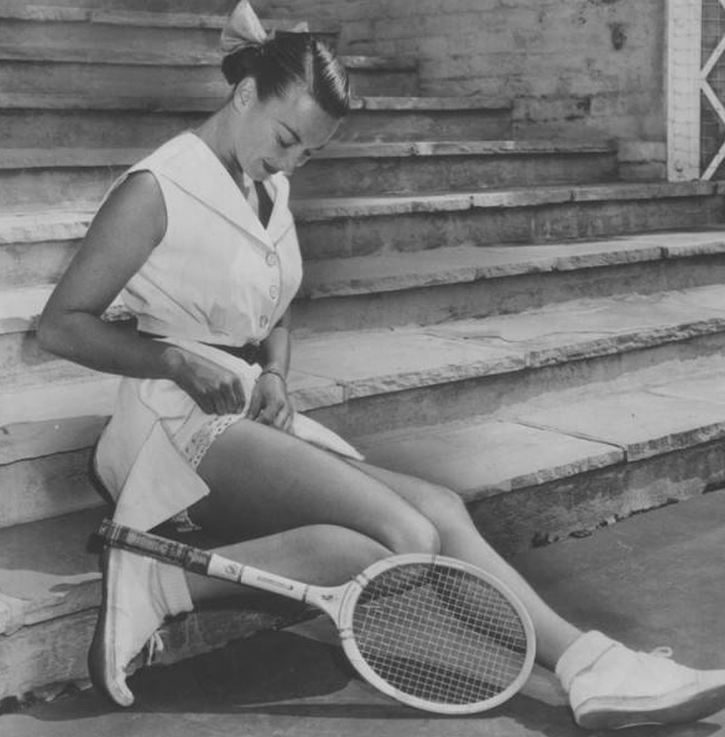
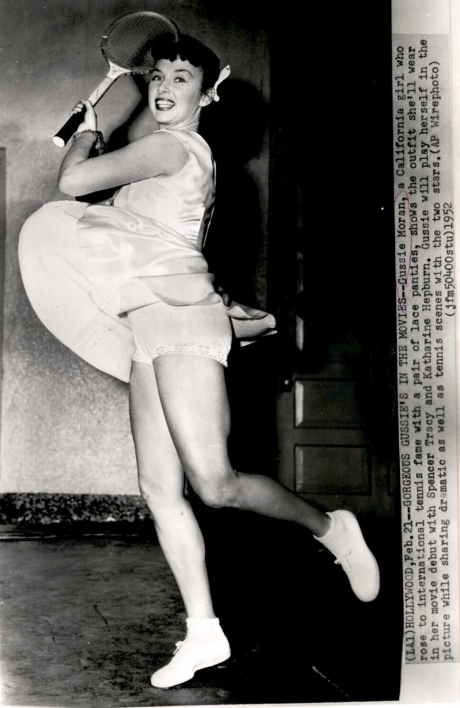
Three decades later, American play Gussie "Gorgeous Gussie” Moran commissioned British designer Ted Tinling to make her something bolder for her 1949 Wimbledon debut. What he produced was, by today’s standards, tame: a knee-skimming dress with matching lace-trimmed undershorts, reportedly improvised at the last minute when the right undergarments weren’t on hand. It didn’t matter. Photographers crawled on the ground to get low-angle shots of the lace. At the time, this was the ultimate outrage. Wimbledon’s chairman accused Tinling of “having drawn attention to the sexual area”, and officials declared that Moran had brought “sin and vulgarity” into the game. The punishment was absurdly disproportionate: Tinling, who had served as an official Wimbledon host for 23 years, was banned from the grounds for the next 33 years. Funny enough, he still was technically allowed to continue designing. The scandal was so large it reportedly prompted debate in the British Parliament, over a strip of lace that was visible for seconds at a time.
About a decade later, Brazilian star Maria Bueno stepped onto the Centre Court in yet another Tinling creation, and this one caused even more outrage. This specific outfit showcased flashes of pink-colored and patterned undershorts peeking out from under her skirt. Wimbledon’s response was not to loosen its grip, but to tighten it even further, cementing the all-white dress code that still governs the courts today. To summarize, two women wear clothing that briefly reveals what’s underneath their skirts, and the institutional response both times is to write more rules about women's bodies.
By September 1973, the stakes had shifted from a courtside scandal to something closer to a referendum. At the Houston Astrodome, Billie Jean King faced Bobby Riggs at the “Battle of the Sexes”: a match that functioned, fairly or not, as a public trial of whether women belonged on the same court as men at all. Tinling, unsurprisingly, was also the designer of King’s dress during this tournament. Billie Jean King gave him lots of freedom, but with one limitation: no pink. While King did not have any specific disdain for pink in general, she did refuse any association to gender stereotypes. She iconically beat Riggs in straight sets, wearing an outfit she had chosen on her own terms. The fight wasn’t just to wear something different while playing tennis, it was more so for the right to choose.
Now, let’s examine the iconic tennis stars of the modern age. Serena Williams turned catsuits and tutus into a fashion statement, and an iconic one at that. Or Naomi Osaka and Coco Gauf, who move fluidly between their personal style and performance wear. Jelena Ostapenko has built a reputation completely around her tennis style, particularly through the use of bold prints and unexpected color combinations. A number of players, including Madison Keys and Diane Parry, now simply play in shorts, opting out of the skirt entirely. This is done without a controversy and without a ban, just as it should be!
The ability to choose it is ultimately the most important shift that has been made within the world of female tennis players and performance wear. While the skirt may feel mandatory, it definitely is not. What is real, however, is a century of women fighting to be more comfortable on the courts. The garment outlived the enforcement. What’s left on the court today is an evolution of a habit; an aesthetic default so deeply worn in a sport’s visual identity that it can look like a requirement. The players who reach for shorts, colors, or something entirely new aren’t breaking any rules. Instead, they are simply the latest in a line of iconic women, just like Lenglen, Moran, Bueno, and King.